
Allyce Wood
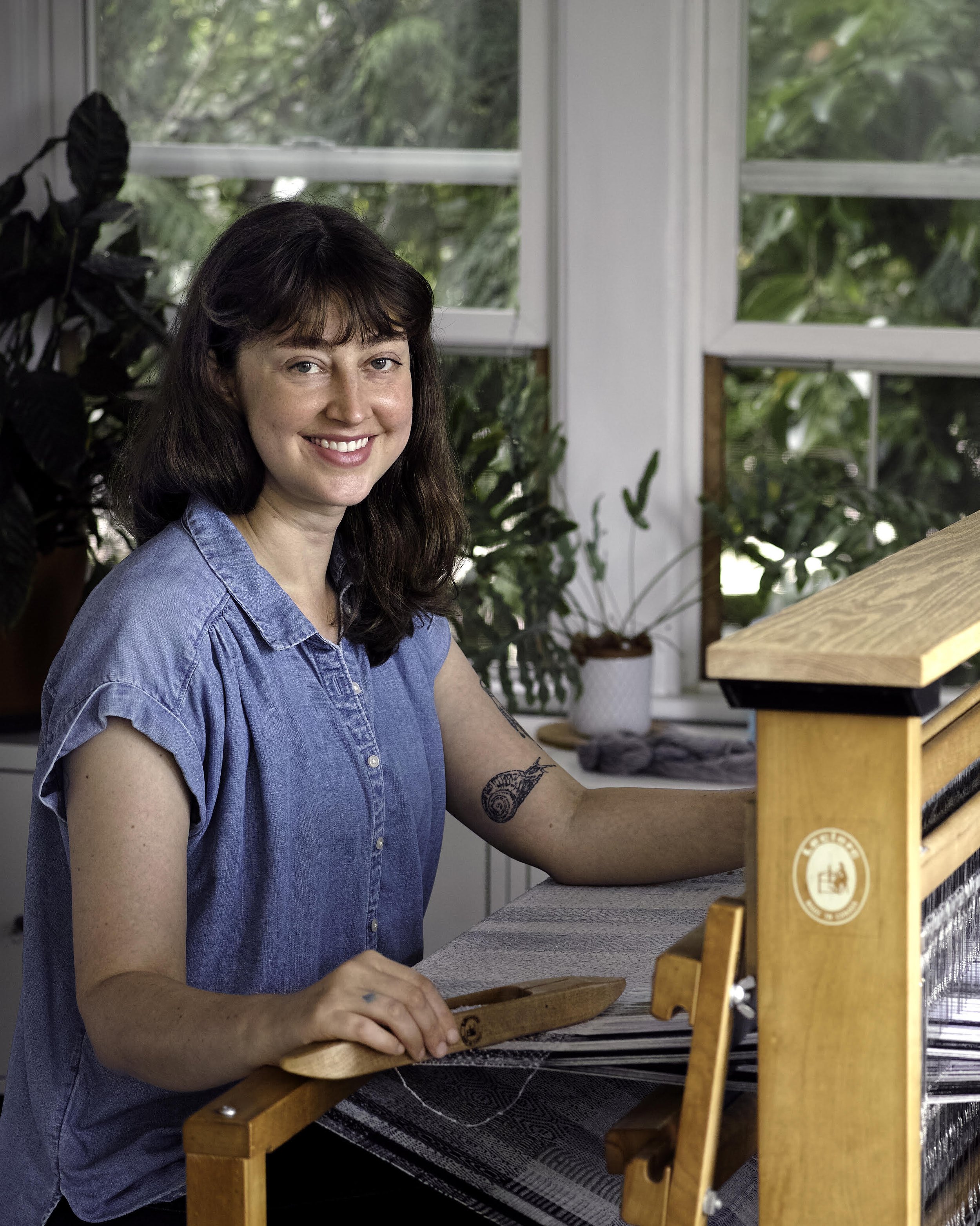
Allyce Wood, studio portrait by Pete Fleming
NWDC is pleased to share the art and ideas of Allyce Wood.
Allyce Wood lives and works in Seattle. Through the use of digital and handmade processes, Wood makes installations, works on paper, and textiles with a focus on digital jacquard tapestries. To her, the loom acts as a mediator between traditional and computerized technologies, offering a unique way to combine online and offline experiences into images in cotton and wool.
Wood is a collector of technologies and threads. In the studio, she creates textiles on her mid-century Bergman floor loom, a passed-down marudai, and a knitting machine from the 1960s that she restored piece by piece. Every process tells a story of a different code system. Punch cards and graph paper are as vital as the bleeding watercolors she paints with. This passion for systems, for breakable rules, stems from a lifelong curiosity of reason and rule-bending.
How were you introduced to art?
I was lucky to have been introduced to art at a young age. I grew up in a household that celebrated creativity and art appreciation. As tiny kids, my sibling and I were always drawing, doing projects, and taking research trips to borrow monographs from the library; any material or subject matter that piqued our interest was encouraged. My grandmother loved the Frye Art Museum, and I remember taking special family trips there, looking up at the salon wall, talking about what each piece meant to us. Art, in its many forms, was an important cornerstone of growing up.
Where do you find inspiration when creating new work?
As an artist who now focuses on weaving as my main medium, I look both backward and forward in time for inspiration. Books from the 19th century, full of hand-drawn drafts and personal notes, excite a part of my brain in the same way a text from a friend, sharing a photo of a fabric sample picked up at an estate sale, does. Sometimes its color, a special yarn that finds its way to me through thrifting, or the light that comes in from my West Seattle studio window. Research into the work of artists like Sheila Hicks, Annie Albers, and Lenore Tawney inspires me, as does going to local exhibitions in and around Seattle. There are so many ways to weave, and I'm so fascinated to learn how others connect with the medium. Creating opportunities to share, collaborate, and listen are always at the center of my work.
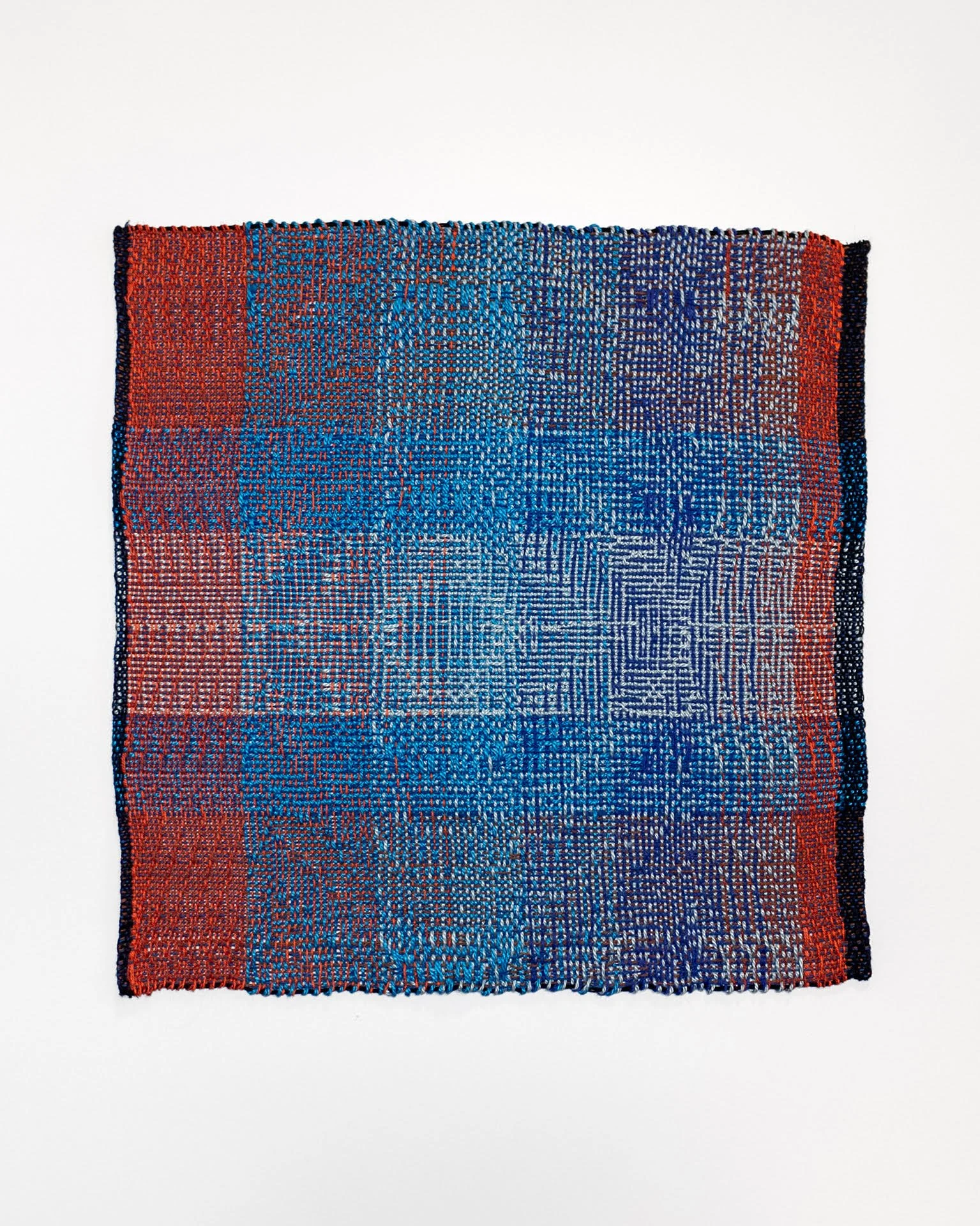
“Oculus,” handwoven tapestry in hand-dyed and commercial cotton and cotton blend fibers, 14” x 14”, 2025 (photo credit Pete Fleming)
What do you consider your greatest artistic achievement?
There have been many highlights, but I will say my solo exhibition 'Glimmering Code' at Gallery 4Culture was a special moment in my career. It was a great experience, and one of the few times I've been able to showcase all of my various textile techniques in one space. It enabled me to delve deeply into some key concepts and share them with the wider Seattle community. This show explored the relationship between traditional textile making and the boundless potential of computer-aided production, where manual labor and machine language overlap. Woven and knit images of lit flames, arching vistas, and portals revealed intricate personal connections and a longstanding collaboration with code-driven machines, while the warmth of the materials contributed to a sense of familiarity and optimism.
You can see images of that show here: https://www.allycewood.com/glimmeringcode
What is the quality you most like in an artist?
Determination. So much of being an artist is to be resolved in your work. Committed to the project, to the vision, to continuing on. I've had fabulous mentors of artists working in their 50's, 60's, 80's, and even 90',s and the way that they commit to their art through all seasons of life has been a great lesson. The determination in the way they prioritize their studio, uplift others, and strive to delve deeper into their artwork is by far the most impressive quality to me.
Which living artist do you most admire?
I have a long list, but today I will highlight artist and weaver Kay Sekimachi. Her work spans three-dimensional monofilament hanging structures, multimedia fiber objects, tapestries, and textiles that demonstrate her exceptional handwork, heart, and ingenuity. Her rice bags and box forms are so beautiful in their quiet, polished construction. Sometimes they feel ghostly, a breathe come to life, while other times they feel rooted, almost eternal in their earthiness. Her piece 'Tzedakabako-a' is a piece I particularly love. It is an alms box she wove as a commission to the Jewish Heritage Museum in 2000. It has crisp linen construction, a stenciled and dyed design, and a soft folded lid. Pristine, bodied, and exquisite. To me, it exemplifies the generous potential of weaving and cross-cultural understanding, which feels like real peace. Her life story and her work, full of research and exploration, commitment to her relationships and community, and her years of perseverance, are all so inspiring.
If you could change one thing about yourself, what would it be?
Like most people, I have some bad qualities and nagging habits that could use some shaping; I am always trying to break up with my phone (no luck so far) and stay on the fun side of procrastination, but I'd like to make strong motions towards self-compassion and away from perfectionism. It's easy to love a misplaced thread in another person's work, but I'd like to be able offer myself and my work the same perspective.
What is your most treasured possession?
I'll say our art collection. Is that cheating? We have art everywhere in our apartment. I love the slightly surreal pink mountain paintings, which I look at every morning as I wake up, the black and white 'Brain Baby' in the living room, the dramatic race car painting hung behind our dining table, and the various riso posters in our entryway. Each piece we display was made by a friend from Norway, from Scotland, from way back in college, or from local exhibitions. Having art from all the various places we've lived really makes our home our home.
Who has had a significant influence over your work?
My husband and partner, Pete Fleming, definitely! We met in undergrad, and from even those early days, he has been the most inspiring, encouraging, and supportive person. I am so grateful to have built a life with someone who values studio time, big, weird ambitions, rabbit holes of obscure research, and, of course, expanding yarn collections. We believe in each other as artists and share in the details of our artistic pursuits, offering advice and encouragement even after long days. I am greatly inspired by how he investigates and builds his work with deep consideration for the environment and the audience, by his craftsmanship, and his special eye when creating art. His determination fuels my determination, and Iike to think, vice versa. Our conversations about the ever-evolving role of art and what it can do for the public, for ourselves, for our future histories, do a lot to keep me going, weaving away.
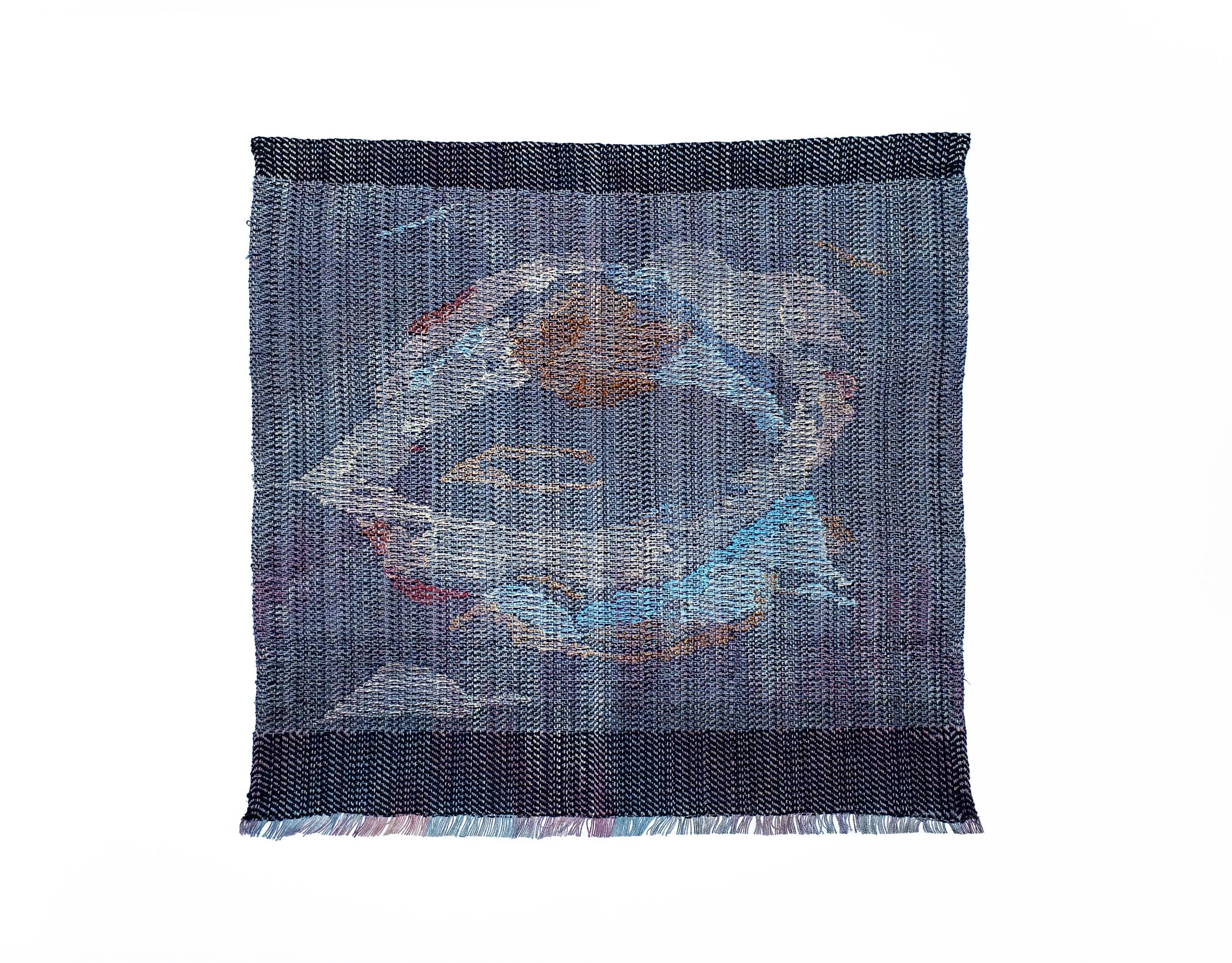
“Lipidity,” hand-dyed cotton warp and reclaimed cotton weft with inlay, 22” x 21”, 2025 (photo credit to the artist)
How has your studio practice changed?
As time goes on, my practice has become more deliberate, focused, and ergonomic (got to keep that back healthy!). The chaos of having a different project on ever flat surface of my home was common in the early days, but now I have eased into new systems. Rather then drawing and scheming for days on end, I trust a doodle and an hour or two of drafting will be enough for me when I reach the loom. Time is now blocked for finishing, organizing, and archive management. Writing about my work and sharing it in either exhibitions or online feels like a lighter, more incorporated lift then it used to. There are still flurries brought by itchy fingers and too many ideas, but for the most part, the steady flow of weaving has brought a pace and structure that is so beneficial. Each work exists in its own time, which i think shows in its final construction.
What is your idea of perfect happiness?
The moment when the coffee on your table is still warm, the light is gold, and you have just cut your warp off from the front beam of the loom. That moment is pure happiness, a moment in which labor, material, and time culminate. A new precipice is what gives me joy.
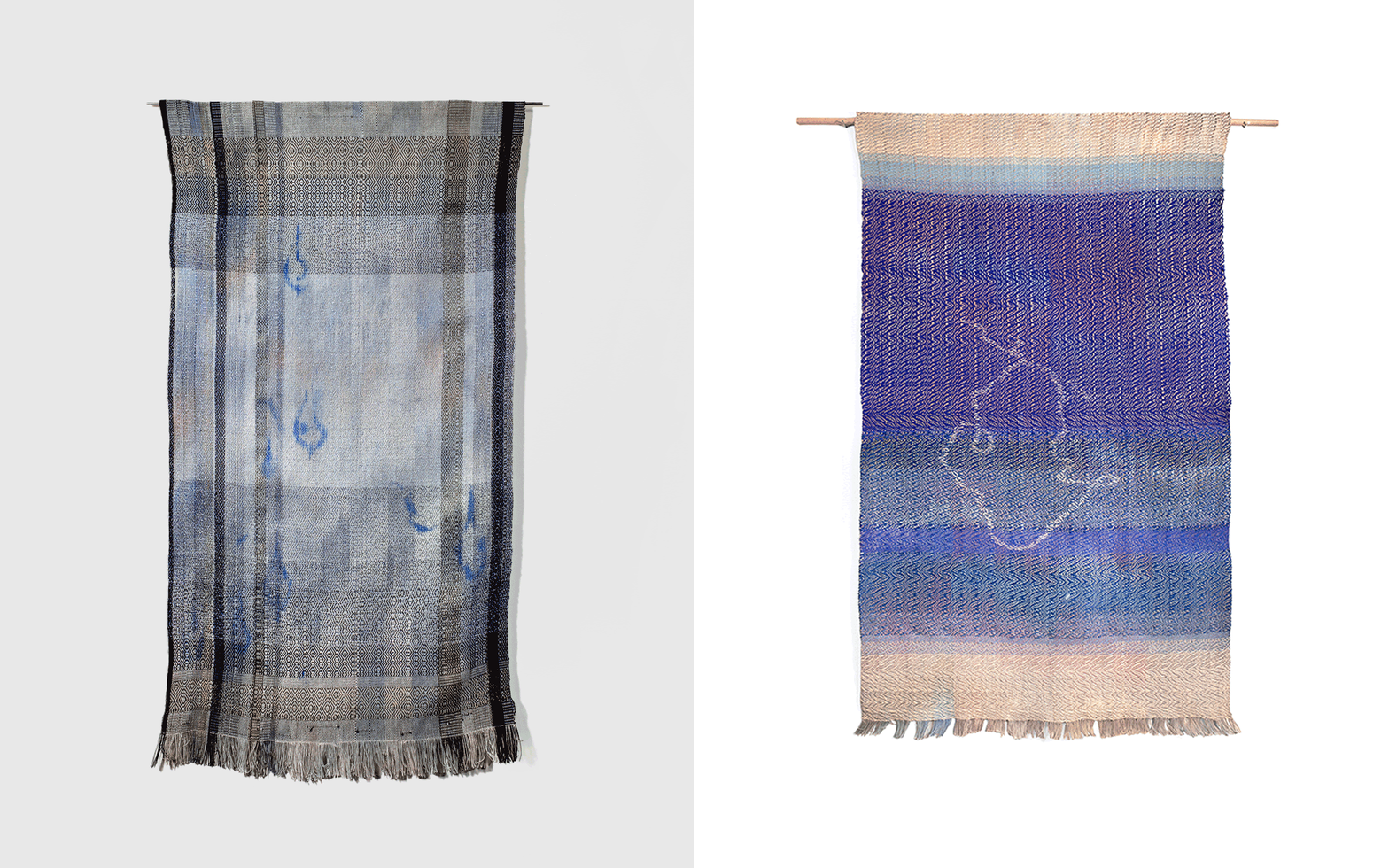
“Teardrop,” handwoven textile with undulating twill, various fibers, partial ikat, and acrylic, 50 x 25", 2025 (photo credit to the artist) / “Downpour”, handwoven textile in undulating twill, various fibers, partial ikat, and acrylic, 50 x 25", 2025, (photo credit to the artist)